A critical vulnerability is disclosed in a widely used software component. Within minutes, the CEO asks the CIO a straightforward question: “Are we exposed, and which of our most business-critical applications are affected?”
The question takes seconds to ask. To the CEO, it sounds like a question that should take seconds to answer.
Then the other requests begin. The board wants to understand the potential business impact. The general counsel asks about disclosure obligations. The head of customer service wants to know whether customers could be affected. Messages and emails pile up while security, architecture, and application teams work to assemble a defensible answer.
Security teams check scanning results. Application owners confirm where the component is used. Architects trace dependencies. Someone must connect the technical findings with application criticality and business impact. Each team may hold part of the truth, but no one has the complete answer the CEO needs.
The CIO is living inside the gap between executive expectations and enterprise reality. That gap is decision latency: the time between recognizing that a decision is needed and having the trusted information required to make it.
Enterprises have lived with this frustration for years. When software portfolios were smaller and changed less often, the delay was often manageable. Today, software estates are expanding, technical debt is accumulating, and vulnerabilities can move from disclosure to exploitation in days. Decision latency is no longer simply an operational inconvenience. It is a source of business risk.
Four questions that can no longer wait days
1. Are we exposed to this vulnerability, and which business-critical applications are affected?
This is the clearest example of why time matters. Google Cloud Security reported that the window between vulnerability disclosure and mass exploitation collapsed from weeks to days during the second half of 2025, with exploitation observed in some cases within approximately 48 hours. Meanwhile, the 2026 Verizon Data Breach Investigations Report found that vulnerability exploitation had become the most common initial access vector in its dataset. Only 26% of critical vulnerabilities were fully remediated during 2025, and median full-resolution time reached 43 days.
Knowing that a vulnerability exists is only the beginning. Leaders need to know whether it exists in their environment, where it appears, which applications support critical business functions, and where remediation should begin. Every hour spent determining scope reduces the time available to manage the actual risk.
2. Which applications are creating the greatest drag on modernization, and where should we invest first?
Most modernization programs do not lack candidate applications. They lack an objective way to prioritize them. Leaders need to weigh technical debt, cloud maturity, application health, business importance, dependencies, and likely effort. When those factors are maintained by different teams, portfolio decisions can become prolonged negotiations based on partial evidence. Faster access to a consistent fact base helps leaders direct investment toward the applications where modernization can produce the greatest business impact.
3. Where can we safely accelerate development with AI, and which applications are not yet ready?
AI coding agents can improve productivity, but the opportunity and risk are not uniform across an application portfolio. Some systems have architectures, documentation, maintainability, and guardrails that make them strong candidates. Others carry complexity, security exposure, or fragile dependencies that require preparation first. Executives need a portfolio-level view of where AI can create value now, where added context is required, and where human oversight should remain especially strong.
4. If we need to reduce technology costs, which applications are the strongest candidates for retirement or consolidation?
Cost-reduction mandates often arrive with tight timelines. Application rationalization, however, depends on more than identifying duplicate names in an inventory. Leaders must consider functional overlap, business criticality, technical health, cloud posture, ownership, and the risk of change. If that analysis takes months, the organization loses time in which savings could have been captured. Timely portfolio intelligence can turn a broad cost target into a defensible set of actions.
The value of shortening the path to insight
Research highlights the gap between how quickly businesses need to act and how quickly trusted information becomes usable. IBM has observed that organizations with advanced data capabilities may still require days or weeks to fulfill multi-step data requests. The data may exist, but accessibility, governance, translation, and coordination delay its use.
PwC’s 2026 Digital Trends in Operations Survey found that 87% of operations leaders said poor data quality had impeded value from digital initiatives. Meanwhile, 89% agreed that actionable data is more important than comprehensive data.
The principle is clear: information creates the most value when it is trustworthy, relevant, and available while there is still time to act. Although there is no universal formula for the cost of delay, its effects are familiar. Risk remains unaddressed, resources stay tied up, teams wait for direction, opportunities are missed, and skilled people spend time assembling answers instead of acting on them.
Fast answers still need a trustworthy foundation
Generative AI has changed expectations about how quickly a question should be answered. But in enterprise technology, a fast answer is useful only when leaders can trust what it is based on. A fluent response assembled from general model knowledge is not a substitute for evidence about an organization's actual applications.
The underlying intelligence therefore matters as much as the conversational experience. Software decisions should be grounded in consistent, repeatable analysis of the portfolio: application health, technical debt, open-source risk, cloud maturity, AI readiness, business context, and other facts derived from the software itself. Natural language can make that intelligence easier to reach, but it should not weaken the rigor behind it.
The goal is not zero time to decision. Leaders may still need to weigh tradeoffs, consult experts, align stakeholders, and exercise judgment. The goal is to eliminate unnecessary time between the question and the facts.
A new way to access portfolio intelligence
‘Ask CAST’ brings this model to enterprise application portfolios. It allows leaders to ask questions in natural business language through MCP-enabled AI tools such as ChatGPT, Claude, Gemini, and Microsoft Copilot, as well as experiences delivered through Microsoft Teams. Answers are available immediately and grounded in the latest deterministic software intelligence from CAST Highlight.
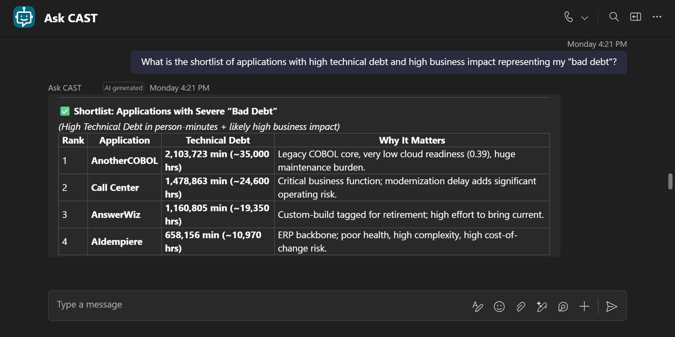
This means an executive can ask a question in the AI environment already open on a laptop or phone, without learning another specialized interface or navigating a series of dashboards. The conversation can continue naturally: Which critical applications should we address first? Which business units are affected? What factors drove that prioritization?
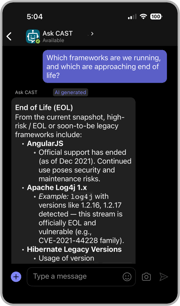
This conversational model changes more than the user interface. It reduces reliance on a sequence of manual requests whenever a new question arises. It gives leaders access to a shared, portfolio-level fact base while the question is still relevant. And it allows security, architecture, cloud, finance, and application teams to spend less time repeatedly assembling information and more time advising, prioritizing, and acting on it.
Ask CAST does not replace the expertise of those teams or make executive decisions on their behalf. It brings their underlying software intelligence closer to the moment of decision.
From question to action
As software estates grow and the pace of business accelerates, critical questions will not arrive on a convenient schedule. The next vulnerability, cost mandate, modernization decision, or AI opportunity may surface in a board meeting or operating review where leaders expect an answer now.
The organizations that move fastest will not simply have more data, dashboards, or AI. They will make trusted intelligence available at the moment it is needed.
The question may still take only seconds. Increasingly, the answer can too.
